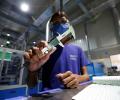
'The government should put the whole road map together for the vaccine and decide how industry can support...' 'They should allow the private sector to vaccinate.'

The expert committee sought more information from Serum Institute regarding the Oxford-AstraZeneca vaccine.

The Serum Institute of India has stockpiled 40 mn-50 mn doses and is adding more every week. Most of these will come to India.

Bharat Biotech recruited 13,000 participants for the Phase-3 clinical trial of Covaxin. This is one of the largest efficacy trials held in the country.

For vaccination, online registration is mandatory. Thereafter, eligible beneficiaries will be informed on their registered mobile number about the nearest vaccination facility, and the date and time of vaccination.

Experts say this further underlines the lack of investor interest in stressed assets at present.

The company has developed detailed logistical plans and tools to support effective vaccine transport, storage, and temperature monitoring. Sohini Das and Ruchika Chitravanshi report.

One of the changes being proposed is allowing LLPs to issue non-convertible debentures.

The criteria for allowing companies to avail of this provision will include profitability, networth, paid-up capital, and turnover.

HR experts estimate that up to 70 per cent companies in the manufacturing and services space including sectors like auto components, edutech and construction equipment are looking to restore the salary cuts over the next couple of months.
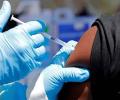
Vaccine development is a long process to ensure safety and efficacy through different stages and involves regulatory supervision every step of the way. Ruchika Chitravanshi takes you through this carefully drawn journey of vaccine development.

Funding challenges are not limited to just one think tank. Several scholars say that access for conducting research and getting foreign funds has become a major hurdle for think tanks, with the government raising many questions regarding such inflows. As a result, many think tanks are keeping a low profile and becoming less prolific.

Unsurprised by the rising numbers, epidemiologists are concerned about the virus reaching rural and tribal areas where the health infrastructure is weak, reports Ruchika Chitravanshi.

'Students are taking a keen interest in a hybrid model, where they start classes online and then complete the course on campus.'

Indian companies are required to hold AGMs within six months of closure of the financial year.
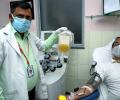
While the process of extracting plasma itself is simple, doctors say that it is the screening of donors, testing and filling up of numerous forms that takes time.

Iyer, popularly called Param, is keen to return to the US where he had spent several years working with the World Bank at its Washington office -- a job he later quit to become road manager for his daughter, a professional tennis player.

The two cities finally got their act together by ramping up the testing capacity and implementing stricter quarantine norms.

Many experts feel the concept of a national peak is nebulous, given that the growth in case numbers is dominated by a handful of states.
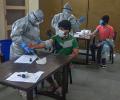
The ministry of health and family welfare spent Rs 3,948 crore in May this year compared to Rs 7,816 crore in the corresponding month of the previous year. On the other hand, at Rs 12,930 crore, the expenditure had risen almost 200 per cent in April against Rs 4,327 crore in the corresponding month of 2019-20.
 © 2026 Rediff.com - Advertise with us - Disclaimer - Privacy Policy - Sitemap - Feedback - About us - Terms of use - Grievances